
Heated shop painting: watch the wall
Garages, shops and pole barns around Brighton, painted right in the cold months.
By Painter Hotline · Published
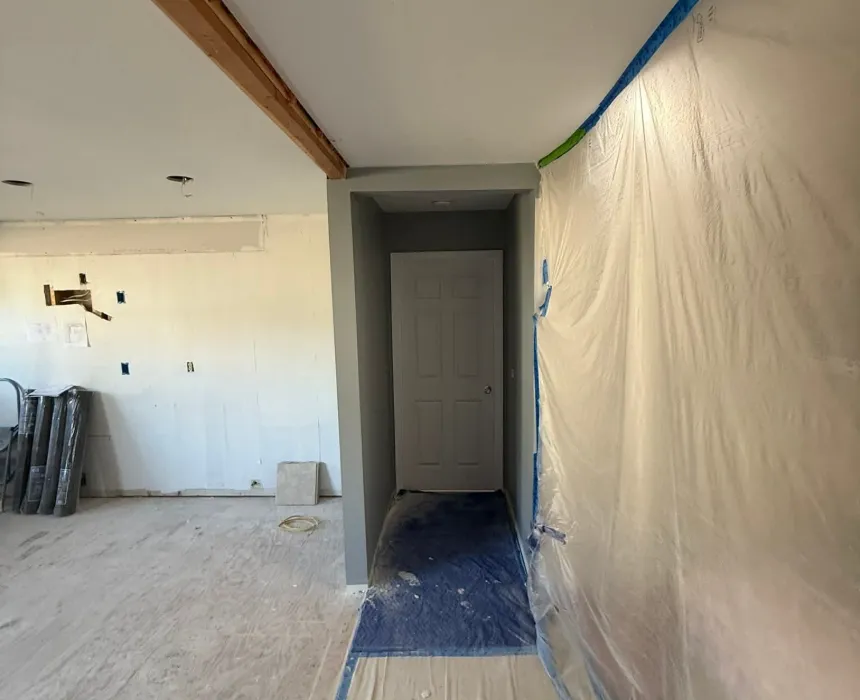
A heated garage, shop or pole barn can be painted in January, as long as the walls themselves stay above the paint’s minimum and at least 5°F above the dew point until the coating dries. Concrete block, slabs and steel stay cold long after the air warms, so preheat the building, measure the surfaces, use vented or electric heat, and pick tougher coatings for the lower walls where trucks and tools hit.
Why the air temperature lies to you
The heater has run since breakfast and the thermometer on the post says 58°F, yet the north block wall can still be far colder. Masonry, slabs and steel are heavy and slow to warm after a cold night. Air warms in minutes; a block wall can take a day or more.
Paint does not care what the air is doing. It cares about the surface it lands on. Latex rolled onto a wall below its minimum may look fine, but the film doesn’t form properly and can crack, stay soft or lose adhesion.
So on every winter shop job we use an infrared thermometer on the actual walls, especially exterior walls, corners near the overhead door, and anything shaded from the heater. If the coldest surface we plan to paint is under the product minimum, we wait or we heat longer.
The two numbers: 35°F and 50°F
Sherwin-Williams puts traditional latex at roughly 50°F. Several of its lines, including Duration, Resilience, SuperPaint, A-100 and Emerald Exterior, are rated down to 35°F. Those cold-rated lines are exterior paints, useful on doors, trim and unheated outbuildings. Inside a heated shop we plan around 50°F unless the label on the specific interior product says otherwise.
The fine print matters as much as the headline number. The Duration data sheet says the air, the surface and the paint itself all need to be above 35°F, and at least 5°F above the dew point. It also says not to apply if temperatures could drop below 35°F within 48 hours. A shop where the heat gets turned down at night breaks that rule even if the painting happened at noon.
- - - - 50°F: traditional latex minimum
- - - - 35°F: cold-rated lines
Sources: NOAA 1991–2020 normals for Denver via NWS Denver/Boulder; product minimums from Sherwin-Williams. Denver is the long-record station used here; open ground east of Brighton can run colder on clear nights.
So we ask owners to leave the heat on, steady, for the whole job and a couple of days after. A building that slides toward the outdoor low every night is an unheated building as far as the paint knows.
Dew point: the problem you can’t see
Dew point is the temperature at which water vapor in the air turns into liquid. If a wall is colder than the dew point of the air around it, water condenses on it. Paint applied over that film does not bond well, and waterborne paint that gets wet before it sets can streak or wash.
Sherwin-Williams points out a related outdoor mistake: painting on a warm afternoon when the night will drop sharply, because dew forms after sundown, and most products need at least 4 hours of drying before moisture hits them.
- Unvented heaters. Propane “torpedo” and kerosene heaters dump water vapor into the room as they burn, so the coldest steel or block starts to sweat. See the heater question below.
- Snow melting off vehicles. A truck parked inside with snow in the wheel wells is a humidifier. We ask that vehicles stay out while we work.
- Wet floors. Washing the slab the morning we paint raises humidity at the worst moment.
Outdoor air along the Front Range is usually dry in winter; Denver Health notes humidity is lower at altitude and drops further in the cold months. A cheap hygrometer tells you more than any weather app.
Ventilating with the doors shut
Nobody wants the overhead door open at 20°F, but a sealed shop is no place to spend a day with coatings. What works:
- Waterborne, low-odor products wherever performance allows. Most wall and ceiling coats in a shop can be waterborne.
- An exhaust fan in a man door or window, pulling air out, with the overhead door cracked a few inches at the far end so fresh air sweeps across the room.
- No open flames with solvent products. If any part of the job uses a solvent-based primer or enamel, pilot lights on water heaters, furnaces or unit heaters in the space get shut off, and the space is aired out before they are relit.
- No engines running inside. Not to warm a truck, not to move a tractor “for a minute.”
Block, OSB, drywall and steel: what each one needs
Acreage shops around Brighton, Hudson, Keenesburg and the Weld and Adams County line come in every kind of construction, and the wall material decides the prep.
| Surface | First step | Watch out for |
|---|---|---|
| Concrete block (CMU) | Clean, then a block filler to close the pores | Cold, slow-to-warm mass; efflorescence (white salts) that has to be removed first |
| OSB sheathing | Stain-blocking primer | Bleed-through from resins and extractives; swelling at cut edges if wet |
| Drywall or taped board | Standard primer on new board | Dings and gouges at bumper height; patch before priming |
| Steel liner panels | Degrease and a primer made for metal | Condensation on cold metal; galvanized surfaces that reject ordinary paint |
| Wood framing or plank | Clean and a wood primer | Knots and sap on new lumber |
Based on our crews’ standard practice; always follow the primer manufacturer’s data sheet for the specific product.
Where trucks and tools live, finish matters more than color
The bottom four feet of a shop wall take abuse a living room never sees: mirrors, tailgates, rolling toolboxes, a mower deck swung around too fast. Flat wall paint scuffs and won’t scrub. We generally put a harder, higher-sheen coating on the lower band, such as an industrial acrylic enamel or a waterborne acrylic-epoxy, and a bright, light-reflecting finish on the upper walls and ceiling so the bays are easier to work in at 5 p.m. in December.
Floors are a separate job with their own rules for moisture and temperature. If you are coating the slab too, Painter Hotline’s guide to garage floor epoxy in Colorado covers it, and floors go last so the walls aren’t dripped on fresh coating.
How a winter shop job runs
- A day or two ahead: heat on and steady, vehicles out, benches pulled off the walls.
- Day one: surface temperatures and humidity checked, walls cleaned, block filled or primer applied.
- Following days: finish coats, ceiling first, lower band last.
- After: heat stays up; equipment goes back when the label allows.
Our barns and outbuildings page covers the exterior side of these buildings, and business-owned shops fall under our commercial painting crews. For a finished space inside the house, see basement painting. The Brighton painting cost guide explains what moves a price.
We can walk the building with you or price it from photos plus the rough size; your call. Book by December 31, 2026, and labor is 25% off; paint and materials are billed separately. Call 720-208-5645 or use the free estimate form.
Shop and garage painting questions
Can I paint a garage or shop in winter if it is heated?
Yes. What matters is the temperature of the walls, not the thermostat reading. Most interior paints need about 50°F, and block walls and slabs lag well behind the air after the heat comes on, so we warm the building ahead of time, check surface temperatures before rolling, and keep the heat steady until the coating has dried.
What is the lowest temperature paint can go on?
It depends on the product. Sherwin-Williams lists traditional latex at about 50°F, while some of its lines, including Duration, SuperPaint, A-100 and Emerald Exterior, can go on down to 35°F. The Duration data sheet adds that air, surface and paint all have to be above 35°F and at least 5°F above the dew point.
Why does a propane heater cause problems when painting?
An unvented propane or kerosene heater releases water vapor along with heat. In a closed shop that raises the dew point, and cold steel, block or a slab can drop below it, so moisture condenses on the surface you are painting. Vented, electric or indirect-fired heat avoids that, and fuel-burning heaters also need fresh air for safety.
What paint holds up best on shop walls?
For the lower walls where vehicles, carts and tools bump, a harder, washable finish such as an industrial acrylic enamel or a waterborne acrylic-epoxy holds up better than flat wall paint. Upper walls and ceilings usually get a bright, light-reflective finish so the space is easier to work in.
Can you paint OSB walls in a pole barn?
Yes, with the right primer. OSB is absorbent and uneven, and its resins and wood extractives can bleed into a light topcoat. A stain-blocking primer goes on first, cut edges and seams get extra attention, and then two finish coats. Expect OSB to show its texture through paint; that is the material, not the job.
Numbers in this guide come from the sources below. Product limits vary by line; the label and data sheet on the can are the final word.
- Paint application temperatures and Duration Exterior Acrylic Latex data, Sherwin-Williams (35°F and 50°F minimums, 5°F above dew point, 48-hour rule).
- Exterior product application FAQs, Sherwin-Williams (evening dew, 4 hours of dry time before moisture).
- 1991–2020 U.S. Climate Normals, Denver station, NOAA National Centers for Environmental Information.
- Denver monthly climate extremes and averages, National Weather Service, Denver/Boulder.
- Dry air at altitude, Denver Health (winter indoor humidity).
Get your shop on the winter schedule
Send photos of each wall, the ceiling and how the space is heated. We can price from pictures or walk the building with you, whichever you prefer.
Rather talk? 720-208-5645