
Deck and fence prep before winter: stain now or wait?
Every fall the same question comes in: can the deck still be stained before the snow? Sometimes. Here is how to decide with real numbers, what to do before the first hard freeze either way, and how much stain spring will take.
By Painter Hotline Brighton · Published
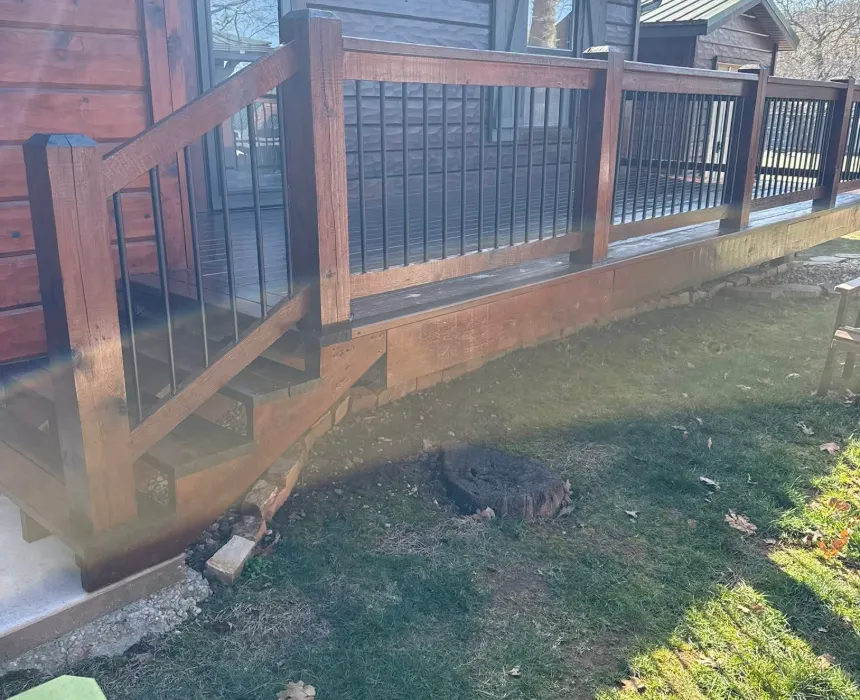
Stain a deck or fence only when it will stay at 50°F or warmer for about 24 hours, the guideline the USDA Forest Products Laboratory gives for latex coatings, unless your stain’s label allows colder. Near Brighton that window usually closes in October: the nearby Denver airport station’s median first freeze is October 9. After that, clean, repair and protect the wood now, and stain in spring.
How much staining weather is left after September?
The closest long-record NOAA station to Brighton is Denver International Airport, about a dozen miles southeast. Its 1991–2020 normals show how quickly warm days run out in the fall and how slowly they come back:
| Month | Days with a high of 50°F+ | Average high | Average low | Nights at or below 32°F |
|---|---|---|---|---|
| September | 29.6 | 79.6°F | 50°F | 0.7 |
| October | 27 | 65.3°F | 37°F | 9.2 |
| November | 18.7 | 52.9°F | 26°F | 22.7 |
| December | 11.1 | 44°F | 18.4°F | 29.2 |
| January | 11.3 | 44.6°F | 18.7°F | 29 |
| February | 11.1 | 45.7°F | 19.7°F | 26.1 |
| March | 21.2 | 55.7°F | 27.5°F | 23.2 |
| April | 24.4 | 61.7°F | 33.9°F | 13.2 |
| May | 29.4 | 71.2°F | 43.6°F | 2.9 |
Source: NOAA NCEI, U.S. Climate Normals 1991–2020, Denver International Airport. Long-term averages, not a forecast.
Two things jump out. First, October still has 27 days a month that reach 50°F on average, but its average low is 37°F, and November’s is 26°F. The afternoon is warm enough; the night is the problem. Second, the spring recovery is slow: the median last freeze at the same station is May 5.
The Forest Products Laboratory’s Wood Handbook is specific: apply latex coatings when it is at least 50°F and expected to stay above that for 24 hours, because most latex coatings do not form a proper film below it. It also warns against applying late in the afternoon if heavy dew is expected, since water landing on a coating that has not set can cause streaking and fading. Some products are made to go on colder, so the label is the final word. On the open plains around Brighton, wind adds one more variable: it dries the surface too fast and drives grit into wet stain.
How do you decide: stain now or wait for spring?
Stain this fall if the boards are clean and dry, the forecast shows a run of warm days and nights above freezing, and the work can be finished early enough in the day for the stain to set before the evening drop. That is realistic for many Brighton decks through early October and for some sunny, south-facing fences later.
Wait for spring if any of these are true:
- The wood needs stripping or a deep clean. Cleaners and brighteners need the wood to dry out fully afterwards, which can take days in cool weather.
- Nights are already dipping into the 30s.
- The deck is shaded for most of the day, so the boards never warm up.
- You are switching products, for example from a solid stain to a semitransparent, which means more prep than a fall window allows.
Waiting is not failure. A deck that is cleaned, repaired and cleared before winter, then stained on the first good stretch in spring, often ends up with a better finish than one rushed in late October.
What should you do before the first hard freeze?
Whether or not you stain this year, these steps keep winter from doing damage that spring has to pay for:
- Clear the boards and the gaps. Leaves and needles packed between boards hold water against the edges all winter. A putty knife or a gap tool clears them fast.
- Move planters, rugs and furniture pads. Anything that sits flat on the boards traps moisture and leaves a pale or dark square in spring.
- Fix popped fasteners and loose railings. Freeze-thaw works them loose further. Angi’s Denver deck guide lists popped nails or screws at about $0.30 per square foot to fix, and railing repairs at $500 to $4,000, so the small fix now is the cheap one.
- Probe for soft spots. Press a screwdriver into board ends, stair treads and the bottoms of posts. Soft wood is a repair, not a staining job.
- Stop water at the source. Turn sprinkler heads away from fence boards and deck skirting, and check that downspouts do not empty onto the deck or against the fence line.
- Trim plants back. Shrubs and grass against fence boards keep them damp and shaded.
- Plan your shoveling. A plastic shovel pushed along the boards is kinder to the stain than a metal edge pushed across them.
- Photograph the worn spots. Gray, bare areas and peeling sections are your spring scope, and the photos make a spring estimate quick.
Stain, solid stain or paint on a deck and fence?
Decks and fences are not the same surface. Fence boards are vertical, so water runs off. Deck boards are horizontal, take foot traffic and hold snow. The Wood Handbook’s guidance reflects that: it calls penetrating finishes an excellent choice for decks and railings, and notes that film-forming finishes on decks often last no longer than penetrating stains while being harder to redo, because a film can peel and a penetrating stain simply wears.
| Finish | Expected life on vertical wood | Best use |
|---|---|---|
| Water-repellent preservative | 1–3 years | Keeping a natural look; easy to reapply |
| Tinted clear (lightly pigmented deck finish) | 2–3 years | New decks where the wood color is the point |
| Semitransparent stain | 4–8 years on saw-textured or weathered wood | Fences and most decks; wears rather than peels |
| Solid-color stain | 6–15 years | Fences and older wood; on deck floors it can peel like paint |
| Paint (primer plus two coats) | 10–20 years | Railings, skirting and fences; rarely deck floors |
Source: USDA Forest Products Laboratory, Wood Handbook (2021), Table 16-3. Figures are for vertical exposure at an average U.S. location; deck floors wear faster.
For deck floors, Angi’s Denver deck guide recommends staining and resealing every two to three years, and puts professional deck staining at $550 to $1,250. The handbook adds two practical points: semitransparent stain on smooth wood lasts roughly half as long as on rough-sawn wood, because less stain soaks in, and saw-textured or weathered wood can take a second coat applied while the first is still wet.
Why not leave new boards bare until spring?
Because sunlight starts breaking down the wood surface within weeks. The Forest Products Laboratory tested cedar boards left in the sun before finishing: boards exposed for 16 weeks needed refinishing within 3 years, boards exposed for 1 week started peeling after 13 years, and boards never exposed were still in good condition after 20. That test used paint, but the lesson carries over: weathered fibers do not hold a finish. If new boards go in this fall and cannot be finished, a thorough cleaning that removes the gray surface before staining in spring matters more than usual.
How much stain will your deck and fence need?
Enter the deck size and the fence run. Coverage varies widely between products and with how rough and dry the wood is, so type in the figure on your can. Rough, weathered boards take noticeably more than smooth new ones.
What does a good spring restain look like?
- Wash with a deck cleaner and rinse. If the old stain is peeling, strip it; new stain cannot hold onto a failing film.
- Brighten if the cleaner calls for it, which evens out the wood color.
- Let it dry fully. In April that can take several days.
- Sand raised grain and any splinters on rails and stair edges.
- Stain on a warm stretch, working a few boards at a time along their full length to avoid lap marks, and finish early enough in the day.
- Stay off it for the time on the label before furniture goes back.
Booking a spring slot over the winter is the easiest way to get done early in the season. Our deck and fence staining page covers how we do it, and the Brighton painting cost guide has the full price picture. If hail hit the deck, read hail damage and your paint first.
Common questions
Is it too late to stain my deck in the fall in Brighton?
Often, by late October. The USDA Forest Products Laboratory advises applying latex coatings at 50°F or warmer with temperatures expected to stay there for 24 hours, and stain labels set their own limits. NOAA’s normals for the nearby Denver airport station put the median first freeze on October 9. Past that, cleaning and repairs now and staining in spring is usually the better plan.
What should I do to my deck before winter?
Clear leaves and debris from the boards and the gaps between them, move planters and rugs that hold moisture, fix popped fasteners and loose railings, trim plants back from the boards, and make sure sprinklers and downspouts are not soaking the wood. Note any gray, bare areas to stain in spring.
Can I stain a fence in November?
Some years, on the right days. The Denver airport station averages about 19 days in November with a high of 50°F or more, but nights there average 26°F. A fence in afternoon sun can work on a warm, dry stretch; shaded runs and late-day application are where it goes wrong.
How often should a deck be restained in Colorado?
Angi’s Denver deck guide advises staining and resealing every two to three years. Vertical fence boards last longer than horizontal deck boards because water runs off them: the Wood Handbook lists 4 to 8 years for semitransparent stain on saw-textured or weathered vertical wood.
Is it bad to leave new deck boards bare over winter?
Bare wood weathers fast. In Forest Products Laboratory tests, boards left in the sun for 16 weeks before painting needed refinishing within 3 years, while boards exposed for only 1 week lasted 13 years before peeling. If new boards cannot be finished before cold weather, protect them and clean the surface well before staining in spring.
Will snow shoveling damage my deck stain?
A metal shovel edge can gouge boards and scrape stain off. A plastic shovel pushed along the boards, not across them, is gentler, and leaving a thin layer of snow is better than scraping to bare wood.
Every number in this guide comes from the source listed. Checked October 22, 2026.
- Wood Handbook, chapter 16: finishing of wood (FPL-GTR-282), USDA Forest Service, Forest Products Laboratory, 2021 (application temperature, finish service life, weathering before finishing).
- U.S. Climate Normals 1991–2020, Denver International Airport (USW00003017), monthly, NOAA National Centers for Environmental Information.
- U.S. Climate Normals 1991–2020, Denver International Airport, freeze dates, NOAA National Centers for Environmental Information.
- How much does deck repair cost in Denver, CO?, Angi, updated October 27, 2025 (sealing and staining cost, restaining interval, repair costs).
Put your deck or fence on the list
Send photos of the deck or fence and we will tell you whether it can be done this fall or belongs at the front of the spring schedule. Free, either way.
Rather talk? 720-208-5645